પસંદ કરેલી કૃતિ · selected work
રેતીની ઓટલી
Reti Ni Otli
The Sand Terrace
Sundaram, Kavi · 1939
Children build a tall, lonely terrace of sand on the seashore and invite the sun, the wind, and the sea to each leave a single footprint. Sundaram's beloved nursery song escalates through cosmic wonder — stars, fairylands, undersea palaces of rubies — only to end pleading with the elements to tread softly, lest a wave erase what a child has made.
દરિયાને તીર એક રેતીની ઓટલી
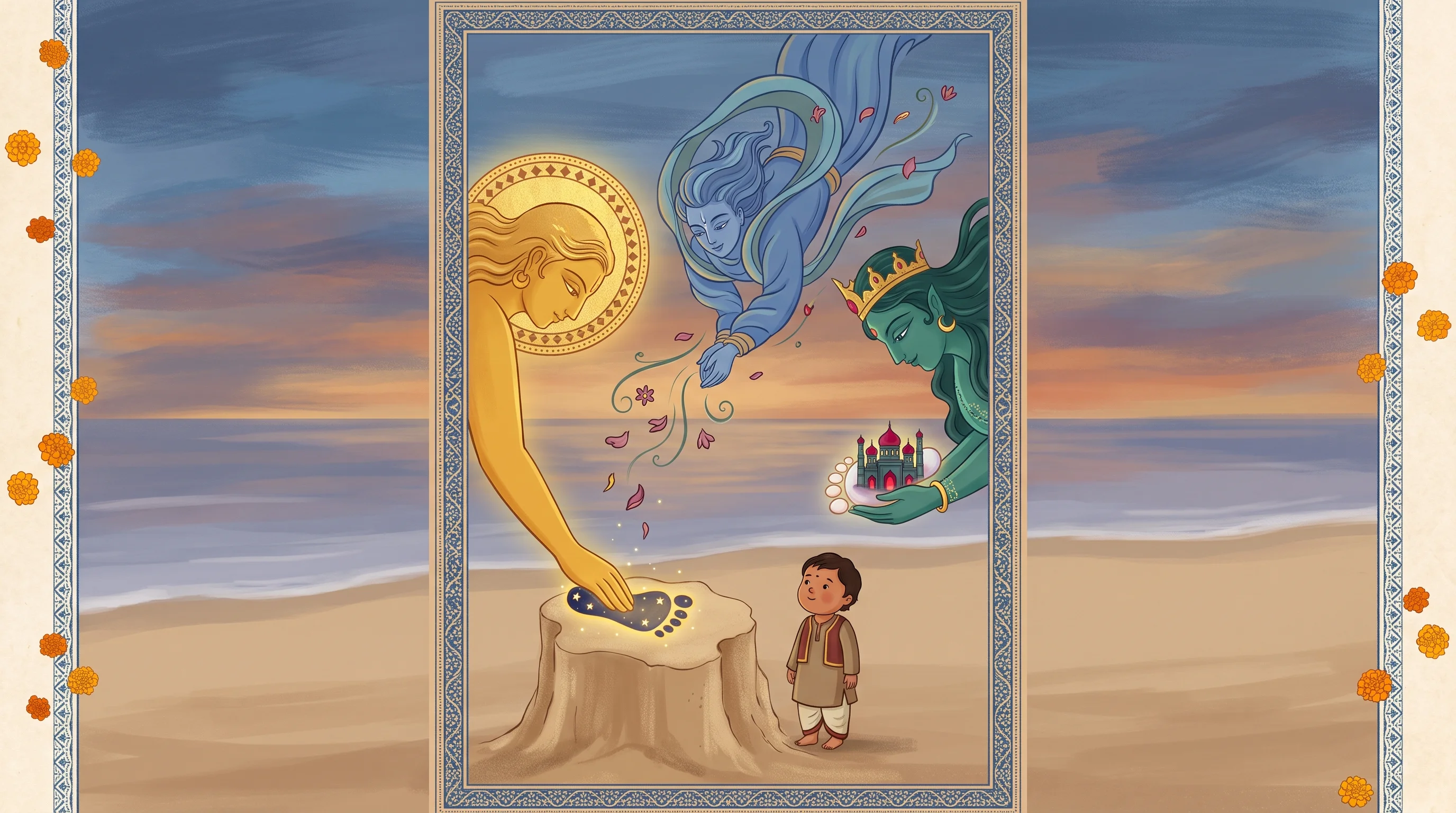
ઊંચી અટૂલી અમે બાંધી જી રે.
પગલું તે એક એક પાડે મહેમાન એમ,
રામજીની આણ અમે દીધી જી રે.
પહેલા મહેમાન તમે આવો, સૂરજદેવ,
પગલું સોનેરી એક પાડજો જી રે,
પગલામાં નવલખ તારાની ભાત ને,
સંધ્યાના રંગ બેએક માંડજો જી રે.
બીજા મહેમાન તમે આવો, પવનદેવ,
પગલું પનોતું એક પાડજો જી રે,
પગલામાં વાત લખો પરીઓના દેશની,
ફૂલડાંની ફોરમ પૂરજો જી રે.
ત્રીજા મહેમાન તમે આવો, સમંદરદેવ,
પગલું મોતીનું એક પાડજો જી રે,
પગલામાં મહેલ ચણી સાતે પાતાળના,
માણેકના દીવા પ્રગટાવજો જી રે.
ધીરે મહેમાન જરા ધીરેથી આવજો,
પગલાં તે પાડજો જાળવી જી ને,
જોજો વિલાય ના એ પગલાંની પાંદડી,
બાળુડે ઓટલી બનાવી જી રે.
This is a બાળગીત — a children's song — from Rang Rang Vadaliyan (1939), Sundaram's collection of verse for the very young, published the same year as his major adult volume Vasudha. The premise is entirely a child's: on an empty seashore, children have built a રેતીની ઓટલી, a tall and solitary terrace of sand ("ઊંચી અટૂલી"), the kind of raised sitting-platform found outside a Gujarati home. Having built it, they issue a decree — binding it with "રામજીની આણ," Ramji's oath, a child's most binding pledge — that every visitor must leave behind exactly one footprint. What follows is a sequence of grave, courteous invitations to three guests who happen to be the elements themselves.
The genius of the poem is the arc it traces between its playfulness and its imagery. Each મહેમાન (guest) is asked for a single પગલું (footprint), and each footprint is a small universe. The Sun is to press a golden print patterned with "નવલખ તારાની ભાત" — nine-lakh, or countless, stars — with two smears of dusk's colours; the Wind, a fortunate print inscribed with tales of fairyland and filled with the scent of flowers; the Sea, a pearl print housing a seven-storeyed palace of all seven netherworlds, lit with "માણેકના દીવા," ruby lamps. Sundaram fuses the cadence of folk lullaby — the plaintive "જી રે" that closes nearly every line, the incremental "પહેલા… બીજા… ત્રીજા" repetition — with the lush, jewelled excess of miniature painting. The diminutives keep the register childlike and fond: not just ઓટલી but ફૂલડાં, પાંદડી, બાળુડે.
Then the final stanza turns, and the whole cosmic pageant collapses into tenderness. "ધીરે મહેમાન જરા ધીરેથી આવજો" — come softly, guests, softly — the children beg, so that the delicate "પગલાંની પાંદડી," the petal of each footprint, will not dissolve, "બાળુડે ઓટલી બનાવી જી રે," because a child made this terrace. The escalating grandeur of stars and undersea palaces gives way to the plain fact that any wave or breeze could erase it all. In a child's voice, Sundaram has written a quiet meditation on the impermanence of the beautiful things children build — which is why the song has stayed in Gujarati school readers and on the lips of children for generations.
સુન્દરમ્
Sundaram — born Tribhuvandas Purushottamdas Luhar in the small village of Miyamatar in Bharuch district — is, alongside Umashankar Joshi, one of the two towering figures of the Gandhian era (*ગાંધીયુગ*) of modern Gujarati literature, a generation whose verse fused Gandhian idealism, social realism, and lyric craft. He wrote first under other pseudonyms before publishing a poem in 1928 under the name *Sundaram* — a Sanskrit wordplay on *su-ndaram*, the beautiful — which he then kept for life. His landmark 1933 collection *Kavyamangala* won him the Ranjitram Suvarna Chandrak, Gujarati literature's highest honour; *Vasudha* (1939) and *Yatra* (1951) followed, and a Sahitya Akademi Award came in 1968 for his criticism, with the Padma Bhushan in 1985. From the mid-1940s he fell under the influence of Sri Aurobindo and settled at the Pondicherry ashram, entering a spiritual, integral phase of writing. Equally at home in coarse rustic satire and in tender children's song, he left one enduring gift to Gujarati childhood — the children's collection *Rang Rang Vadaliyan*, still sung in homes and schools today.
All poems by Sundaram →