પસંદ કરેલી કૃતિ · selected work
ઊંટ કહે: આ સભામાં
Unt Kahe Aa Sabha Ma
The Camel Says: In This Assembly
Dalpatram Dahyabhai Travadi, Kavi · c. 1850
A camel stands in an assembly of animals and mocks everyone else's crooked bodies — the stork's neck, the parrot's beak, the dog's tail — certain of its own superiority. A jackal's one-line reply turns the joke back on the camel, and on anyone too quick to point out others' flaws. One of the most quoted comic poems in Gujarati.
ઊંટ કહે: આ સભામાં, વાંકાં અંગવાળાં ભૂંડા;
ભૂતળમાં પક્ષીઓ ને પશુઓ અપાર છે;
બગલાની ડોક વાંકી, પોપટની ચાંચ વાંકી;
કૂતરાની પૂછ્ડીનો, વાંકો વિસ્તાર છે.
વારણની સૂંઢ વાંકી, વાઘના છે નખ વાંકા;
ભેંસને તો શિર વાંકાં, શિંગડાનો ભાર છે.
સાંભળી શિયાળ બોલ્યું, દાખે દલપતરામ;
"અન્યનું તો એક વાંકું, આપનાં અઢાર છે"
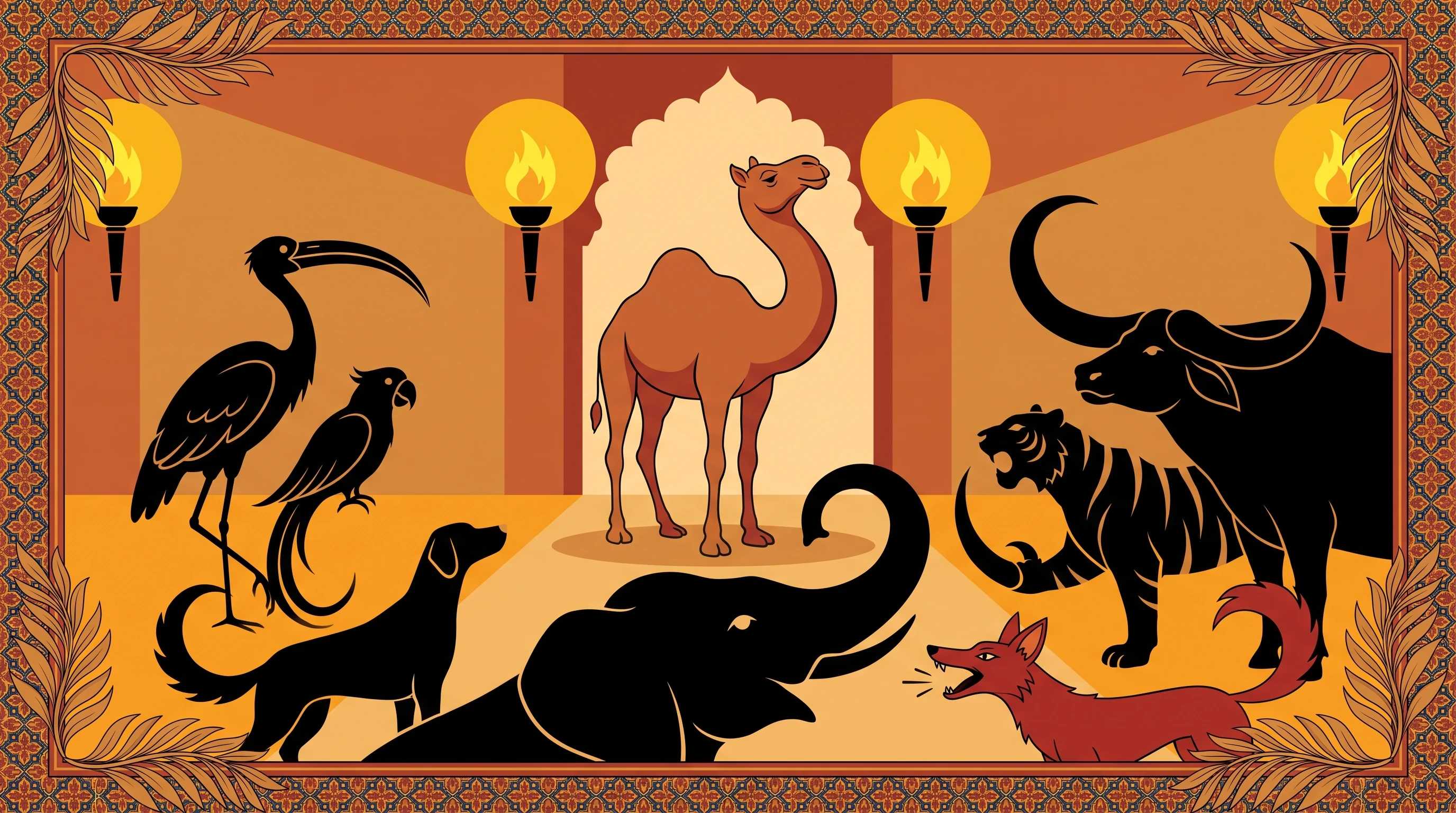
Dalpatram wrote at a moment when Gujarati literature was still finding its feet as a printed, public medium, and he used that new platform for something older societies had always needed — a mirror held up to self-righteousness. The poem stages a mock courtroom: a camel rises in an assembly (સભા) of animals and, with total confidence, catalogues everyone else's deformities — the stork's bent neck, the parrot's curved beak, the dog's crooked tail, the elephant's coiling trunk, the tiger's hooked claws, the buffalo's heavy horns. It is a small, comic bill of particulars, delivered by the one animal in the room whose entire body — neck, legs, back, even its gait — is built from curves.
The technique is pure setup-and-punchline, but Dalpatram's craft is in the patience of the setup. Three full stanzas let the camel's list run on, each line adding one more creature's "flaw" in the same flat, cataloguing rhythm, so that the reader almost forgets to ask who is speaking. Only in the final couplet does the jackal — traditionally the wily truth-teller of Indian fable — interrupt with "અન્યનું તો એક વાંકું, આપનાં અઢાર છે", "others have one crooked thing, you have eighteen." The line lands with the compression of a proverb because it essentially became one: Gujarati speakers still invoke ઊંટનાં અઢારે વાંકા to describe a hypocrite too busy counting other people's faults to notice his own.
The poem's longevity owes something to its usefulness far beyond literature — it has been recited in schools, quoted in editorials, and dropped into arguments for over a century and a half as shorthand for exactly this kind of blindness. That staying power is itself part of Dalpatram's larger project: alongside plays and essays arguing against child marriage and for widow remarriage, he treated humor as a serious reform tool, trusting that a joke people repeat will outlast a lecture they forget.
દલપતરામ ડાહ્યાભાઈ ત્રવાડી
Dalpatram Dahyabhai Travadi was one of the founding figures of modern Gujarati literature, a Sanskrit-trained poet who chose to write for ordinary readers in plain, musical Gujarati rather than for a scholarly elite. Befriended and encouraged by the British administrator Alexander Kinloch Forbes, he helped establish the Gujarat Vernacular Society and edited the journal *Buddhiprakash* for nearly three decades, using both to campaign against child marriage, caste rigidity, and superstition. He wrote *Laxmi Natak* (1850), the first modern Gujarati play, and composed a treatise on Gujarati prosody that scholars relied on for generations. But he is best remembered for verse like *ઊંટ કહે: આ સભામાં*, where sharp comic instinct did the work of a reform pamphlet — teaching a lesson through laughter rather than argument. He was the father of poet Nanalal, who would take Gujarati verse in a very different, more Romantic direction a generation later.
All poems by Dalpatram Dahyabhai Travadi →